
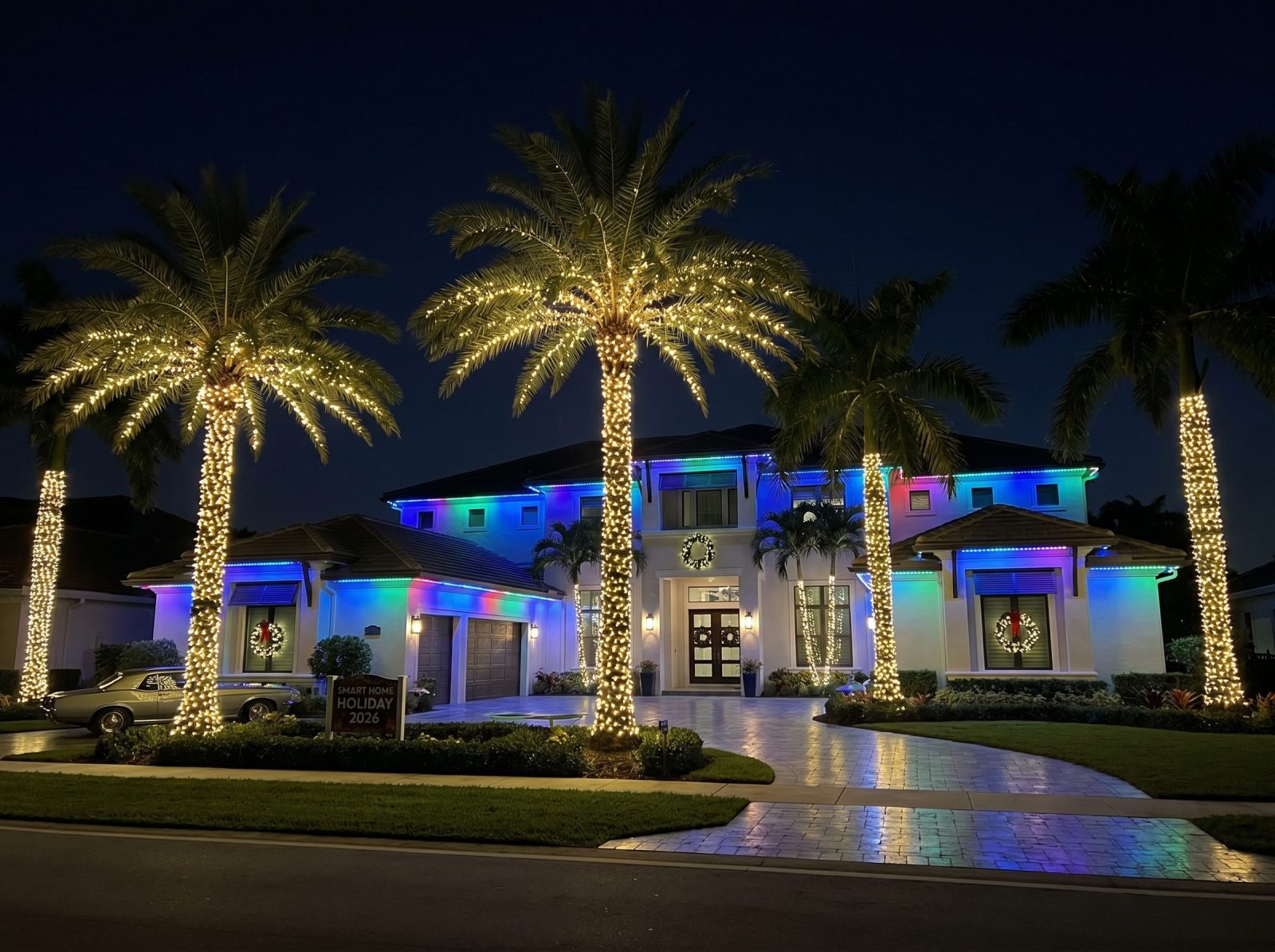
If you think outdoor holiday lighting is still just a matter of untangling a few strings of bulbs and crossing your fingers, think again. This year, a wave of new technology is fundamentally changing how South Florida homes and businesses light up the night. In fact, the tech behind the twinkle has never been more exciting, or more accessible. From AI-powered smart systems to projection mapping, today’s tools can turn your entire façade into a canvas. So if you’re ready to take your display to the next level, here’s everything you need to know about the trends defining the 2026 holiday season.
In this article, you’ll discover:
- How smart home integration is transforming holiday lighting control
- What pixel-level LED technology can do for your display
- How projection mapping works for residential homes
- Why animated icicle lights are replacing the static strand
- The best eco-friendly outdoor lighting options for South Florida
- The “invisible light” design trend taking over high-end installations

Smart Systems Are Running the Show
The biggest shift in outdoor holiday lighting in 2026 isn’t about a specific bulb or color palette. Instead, it’s about control. As a result, homeowners are moving away from piecemeal setups toward fully integrated systems. Now every zone, whether it’s the roofline, the palms, the driveway borders, or the lanai, operates on a single cohesive network managed from a smartphone.
Voice Control Is Now Standard
Voice control through Alexa and Google Home has become standard in higher-end installations. Ask your assistant to turn the lights on, change the color, or set a timer — all without leaving the couch. For South Florida homeowners who entertain outdoors through the holiday season, this level of convenience is genuinely transformative.
AI-Assisted Lighting That Thinks Ahead
The most sophisticated systems of 2026 go beyond simple scheduling. For example, AI-assisted platforms can learn your household routine and adjust lighting automatically. In addition, they sync to local sunrise and sunset times and even adapt to real-time weather conditions. Imagine your display brightening as a storm rolls in off Biscayne Bay, then fading to a gentle glow once your guests leave for the evening. That’s where residential holiday lighting is headed, and it’s available right now.
Whole-Property Zoned Control
Rather than managing individual strands and timers, 2026’s integrated systems allow zoned control across an entire property — pool area, driveway, entrance, landscape beds, and roofline — all as a unified, responsive environment controlled through a single app. It’s the difference between a collection of decorations and a truly designed display.

Pixel-Level LED: The Magic Is in the Details
LED technology isn’t slowing down. This season, the most impressive displays are built on individually addressable LEDs, systems where each tiny bulb can be programmed independently. As a result, you get something far beyond a static or color-cycling display. In practice, these setups produce true animation: waves, chases, dissolves, and synchronized sequences that give your home the visual impact of a professional holiday event.
RGBW Systems: Richer Color Than Ever
Color capability has taken a significant leap forward. RGBW systems — combining red, green, blue, and warm white channels — now deliver smoother transitions, richer color mixing, and that coveted warm amber glow that feels unmistakably festive without looking garish. The difference between a standard RGB display and a well-tuned RGBW system is immediately visible and genuinely impressive.
Tunable White: Setting the Mood
Tunable white technology lets you dial in the exact color temperature you want — from a crisp, cool white that pops against a dark South Florida sky to a warm golden tone that turns your porch into the coziest spot on the block. As the standard “warm white” look gets refined in 2026, expect to see more homeowners using color temperature as a deliberate design choice rather than a default setting.
Music Synchronization: The Crowd Pleaser
Music-synchronized light displays have become dramatically more accessible and more impressive in 2026. Modern systems use wireless controllers and pixel-mapping software to choreograph thousands of lights to a holiday playlist — with transitions smooth enough to pass for a professional production. In South Florida, where outdoor entertaining and neighborhood community are core values, a music-synced display becomes a genuine gathering point. Neighbors bring lawn chairs. Kids stand at the curb wide-eyed. Drivers slow down and roll their windows down.

Projection Mapping: Your Home as the Canvas
One of the most jaw-dropping trends gaining ground in residential settings this year is projection mapping. What was once reserved for high-budget commercial events — projecting animated snowflakes, reindeer, or festive scenes across the entire façade of a building with precision — is now available as a consumer and professional residential product.
How It Works
A projector unit aimed at your home’s front face displays animated visuals mapped specifically to the contours of your architecture. The result can be falling snow, climbing elves, a flickering fireplace effect, or a fully animated holiday scene — all without a single strand of lights touching your roofline.
Why It Works Especially Well in South Florida
South Florida’s architectural diversity — mid-century modern façades, coral rock details, stucco surfaces, Art Deco accents — gives projection mapping a particularly compelling canvas. The technology uses the structure itself as part of the visual, meaning a more interesting façade produces a more interesting result.
For homeowners who dread climbing ladders or dealing with the post-holiday detangle session, this is also a genuinely practical upgrade. Set it up, plug it in, and let the software handle the rest.
Animated Icicle Lights: A Modern Take on a Classic
Static icicle lights have been a staple for decades, but the 2026 version is alive. Animated icicle light strands use a cascading effect to mimic dripping or melting ice, which means something a little different in Pembroke Pines than it does in Vermont. But the visual effect is stunning regardless of the temperature outside. These strands come in warm white and full-color RGBW configurations. They pair beautifully with the rooflines and palm trees of South Florida’s residential architecture.

Permanent Fixture Systems: Install Once, Enjoy Every Season
For a growing number of South Florida homeowners, the appeal is simple. Rather than hauling out ladders and boxes every December, they install permanent RGBW fixtures once and enjoy the results for years. As a result, the yearly holiday scramble disappears. Here’s the case for going permanent:
The Case for Going Permanent
- No ladders in December
- No untangling strands in the garage
- No replacing broken bulbs every other season
- No storage headaches in January
- In short, consistent, professional-quality results every single year
These systems are controlled entirely via app, with preset themes for every holiday and occasion as well as fully customizable programming. The upfront investment is higher than a seasonal string light setup, but for homeowners who want a serious, repeatable result year after year, the value is hard to argue with.
Going Green Without Losing the Glow
Sustainability is a priority for a growing segment of holiday decorators — and in South Florida, where the health of the ocean, the Everglades, and our broader environment is a lived concern, it carries particular weight.
Solar-Powered Outdoor Holiday Lights
Solar-powered outdoor holiday lights have improved dramatically in 2026. As a result, better battery storage means displays now run deep into the evening, even after a partly cloudy South Florida day. In addition, many solar fixtures are available in full RGBW configurations. Going solar, therefore, no longer means sacrificing color capability or brightness.
LED as the Responsible Default
Meanwhile, energy-efficient LED options remain the backbone of any responsible holiday installation. They consume far less energy than traditional incandescent strands and last many times longer. In addition, they perform better in South Florida’s heat and humidity. For a region that deals with salt air, high moisture, and the occasional tropical storm, durable, weatherproof LED components aren’t just an environmental choice. They’re a practical one.
The Invisible Light Trend
On the design side of outdoor lighting, a quieter revolution is underway. In practice, high-end designers are concealing fixtures rather than stacking on more of them. The goal is to see the light but not the source. That principle, in turn, gives holiday displays a level of sophistication that visible hardware simply can’t match.
What Invisible Lighting Looks Like in Practice
- LED strips embedded into concrete steps, retaining walls, and driveway edges create “glow lines” — a clean architectural effect that reads as intentional design rather than seasonal decoration
- Recessed in-ground uplights replace bulky pathway lanterns, vanishing into garden beds while casting dramatic upward light onto palms and landscaping
- Slim wall sconces define pergolas, privacy fences, and pavilions without the visual clutter of traditional fixtures
For South Florida homes with strong architectural bones — and there are many — this approach lets the structure itself become the display.
FAQ: Outdoor Holiday Lighting Technology in South Florida
What is the best type of outdoor holiday lighting for South Florida’s climate?
Look for LED systems with weatherproof ratings of IP65 or higher. South Florida’s humidity, salt air, and frequent rain require fixtures built for genuine outdoor exposure. RGBW LED systems from reputable manufacturers are the best combination of durability, color performance, and energy efficiency for this climate.
How much does a smart outdoor holiday lighting system cost?
Costs vary significantly based on property size and system complexity. A basic smart LED roofline system can start around $500–$1,500 installed. Full-property systems with permanent fixtures, app control, and music synchronization can range from $3,000 to $10,000 or more. The Let’s Get Lit team provides free consultations and custom quotes for every project.
Can I control my holiday lights with my phone?
Yes — most modern smart holiday lighting systems include a dedicated app for full control of color, brightness, scheduling, and animation effects. Many also integrate with Amazon Alexa and Google Home for voice control.
What is projection mapping and do I need a professional to set it up?
Projection mapping uses a digital projector to display animated visuals across your home’s façade, synchronized to the contours of your architecture. Consumer-grade projectors are available for DIY setups, but for precise mapping calibrated to your specific home, professional installation delivers significantly better results.
Are solar-powered holiday lights bright enough for a full outdoor display?
Today’s solar holiday lights are far more capable than earlier generations. High-quality solar systems with lithium battery storage can run full LED displays for 8–10 hours after a good day of charging — more than enough for a South Florida evening. For the brightest and most complex displays, a hardwired system remains the most reliable option.
How do I find a professional holiday lighting installer in South Florida?
The Let’s Get Lit team serves Miami-Dade, Broward, and Palm Beach counties with professional holiday lighting design and installation. We handle everything from initial design consultation through installation, seasonal maintenance, and takedown. Contact us for a free estimate.